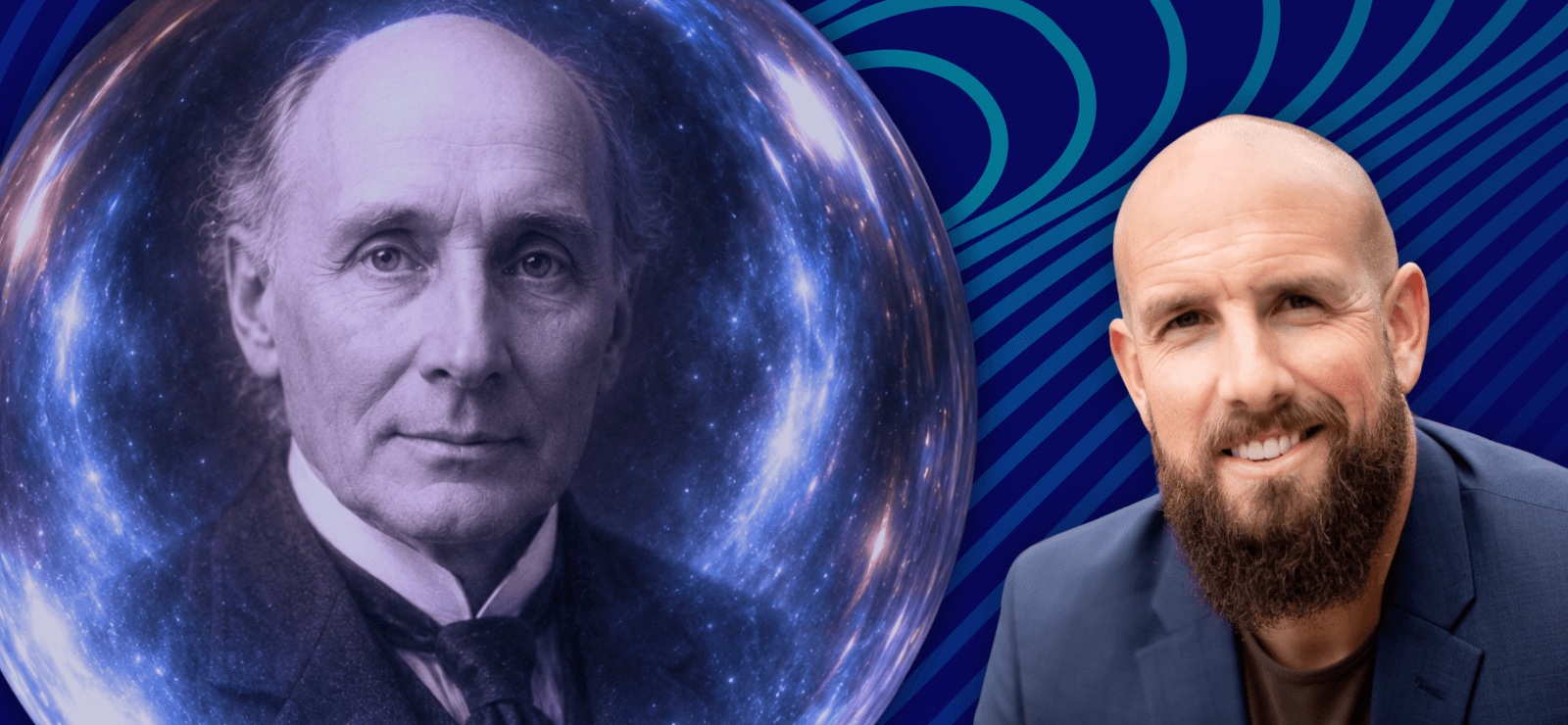
Diving Deeper Into Whitehead's Philosophy of Organism
- WHO: Andrew M. Davis
- WHAT: Five Interactive Sessions
-
WHEN: Wed, 5:00 – 6:30pm Pacific
July 29 – August 26 - WHERE: Online via Zoom
While “process philosophy” is wider than the work of Alfred North Whitehead, the depth and dynamism of his thought principally inspire its modern expression. This five-part course introduces students and life-long learners to the central themes, contours, and ideas of Whitehead’s “philosophy of organism.”
Attend the live class sessions
or work at your own pace.
Course Summary
Whitehead’s “philosophy of organism” is one of the most significant attempts in all of philosophy to think through what reality must be like because you are a part of it. His philosophical vision is at once vast, various, and prismatic. His wife Evelyn once used the wonderful metaphor of a prism to describe his thinking, saying: “It must be seen not from one side alone but from all sides, then from underneath and overhead. So seen, as one moves around it, the prism is full of changing lights and colours. To have seen it from one side only is to not have seen it.” The five sessions of this course aim to reveal the various sides, lights, and colors belonging to Whitehead’s process philosophy from the microscopic to the macroscopic, and in direct relation to your experience as an expression of the universe.
Session one surveys the basic thematic and historical dimensions of “process philosophy” as a current of philosophical thinking with both ancient antecedents and creative modern expressions. Session two dives into Whitehead’s analysis of human experience, clarifies the fundamentals of his “philosophy of organism,” and considers some of the challenges, problems or questions that often emerge from his theory. Session three clarifies the fundamental place of possibility, novelty and value in Whitehead’s philosophy, particularly in relation to human experience as an expression of both biological and cosmological evolution. Session four explores Whitehead’s understanding of the philosophical function of God, including the roles of the “primordial” and “consequent” natures, as well as other important philosophical principles. Session five concludes the course by considering Whitehead’s critiques of the theological tradition and the relevance and/or religious availability of “process panentheism” as a fruitful means of modeling the God-world relationship.
Reality is not static: it is a process of becoming. The fluent character of the togetherness of things was already emphasized in Greek philosophy: All things flow, said Heraclitus. Indeed the fact is too obvious to escape notice. But unfortunately things which are too obvious often escape receiving their due emphasis.
–Alfred North Whitehead
Course Outline
- Session 1: Being and Becoming
- Session 2: Experience Everywhere
- Session 3: Possibility, Novelty, and Value
- Session 4: God as Poet of the World
- Sessions 5: Religion and Process Panentheism
About the Instructor

Andrew Davis
Andrew M. Davis, Ph.D. is an American process philosopher, theologian, and scholar of the cosmos. He is research and academic director for the Center for Process Studies where he researches, writes, teaches, and organizes conferences on various aspects of process-relational thought. An advocate of metaphysics and meaning in a hospitable universe, he approaches philosophy as the endeavor to systematically think through what reality must be like because we are a part of it. He is author, editor, and co-editor of over a dozen books including Mind, Value, and Cosmos: On the Relational Nature of Ultimacy (2020); Process Cosmology: New Integrations in Science and Philosophy (2022); Metaphysics of Exo-Life: Toward a Constructive Whiteheadian Cosmotheology (2023); and Whitehead’s Universe: A Prismatic Introduction (forthcoming, 2026). Follow his work at andrewmdavis.info.
Share on Social Media
Help us spread the word by sharing the course on social media.
Tag us @ctr4process.
Price
- Lifetime access to course session recordings
- Receive early notification of future courses
- Watch live or follow your own schedule
- Interact with course participants via discussion forum